
Cork & Chitin exists for one moment: the evening you bring home a tarantula, a jumping spider or a tub of isopods, and you want the enclosure right before anything goes wrong. Not next week. Tonight.
We publish care sheets, enclosure guides, feeding schedules and bioactive build walkthroughs for US keepers. Every guide is written to be acted on, with temperatures in °F, enclosure sizes in inches and feeding advice given as prey size and frequency per life stage.
No hype, no filler and no guessing. If a number is not well documented, we say so. If two sources disagree, we give you the conservative option and explain why.
Belangrijkste punten
- Every care number is specific and conservative: °F ranges, enclosure sizes in inches tied to leg span or body length, and prey size with feeding frequency per life stage.
- Species pages open with an At a glance specimen label box, so you can act on the basics before reading a single paragraph.
- We name poor beginner species, unnecessary products and hobby myths that are simply wrong.
- Problem guides start with a Quick answer box: the most likely cause, what to do now and when to worry.
- Isopod morph pages always name the species behind the morph and flag permit rules, so you buy legally and with the right expectations.
What we are here to do
Our mission is simple: give you a care sheet you can trust the first night you keep the animal. Most care advice online is either too vague to use or copied from a sheet that was already outdated ten years ago. We write against both.
That means a temperature is never room temperature. It is a range in °F. An enclosure is never appropriately sized. It is a size in inches tied to the spider's diagonal leg span or the isopod's body length. Feeding is never as needed. It is a prey size relative to the animal and a frequency per life stage, from sling to adult.
A sling, by the way, is a spiderling, a young tarantula or jumping spider. Premolt is the phase before a molt, when feeding stops and the animal often looks dull or sluggish. We explain terms like these the first time they appear, because a guide only works if you can read it without a dictionary open.
We also say the uncomfortable things. When a popular species is a poor first tarantula, we say so on its page and point you to beginner alternatives. When a product is unnecessary, we say you do not need it. When a widely repeated hobby claim is wrong, we correct it calmly and with the reasoning laid out.
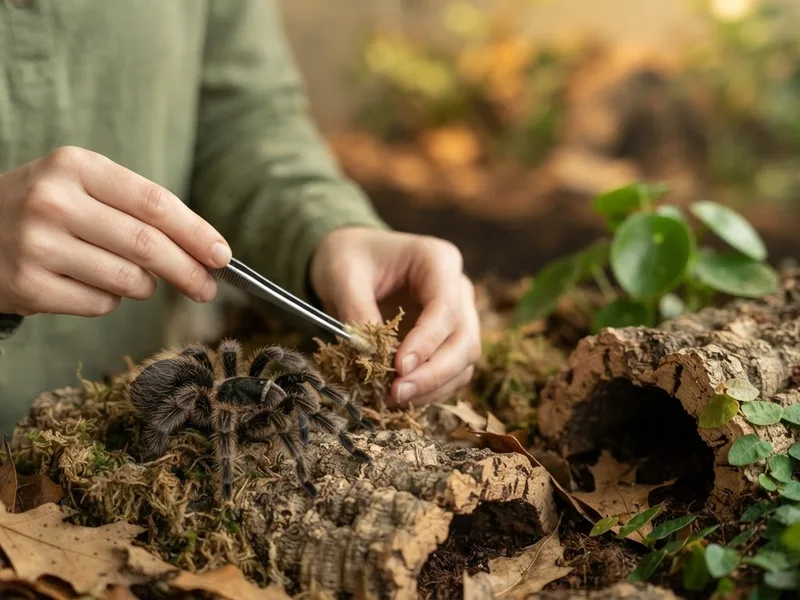
How a guide gets written
Every species page starts with the current scientific name next to the common name, plus the well-known former name where one exists, because hobby listings often lag years behind taxonomy. Then the At a glance box: the numbers you need before anything else.
Where care sources disagree, we default to the conservative option and tell you that we did. Conservative in this hobby means the option least likely to harm the animal: the cooler end of a disputed temperature range, the drier end of a disputed humidity range, the less frequent feeding schedule.
Where a value simply is not well documented, we write that instead of inventing a number. An honest gap is more useful than a confident guess.
Check current consensus
We compare current keeper consensus and available husbandry literature before setting any number. If sources conflict, the conservative option wins and we note the disagreement on the page.
Structure for tonight
Species pages open with the At a glance box. Problem guides open with a Quick answer box. The full explanation follows, but you can act on the basics immediately.
Explain the why
Short paragraphs cover the action. Longer ones explain the reasoning, so you can adapt when your situation does not match the example.
Link the next step
Every species page links to beginner alternatives and to its group's enclosure, feeding and molting guides, so you never land on a dead end.
Correct, then keep correcting
Care consensus moves. When it does, pages are updated rather than defended.
Who we write for
Our main reader is a US keeper, 18 to 45, who just brought home a tarantula, jumping spider or starter isopod culture from an expo, pet store or online breeder. You want the enclosure, the temperature, the substrate moisture and the feeding schedule right tonight. That is exactly how our pages are ordered.
We also write for the people around that keeper. Parents of teens with a first spider who want straight answers about bites and urticating hairs, the irritating defensive hairs many New World tarantulas kick from their abdomen. We cover both plainly and calmly, without drama in either direction.
Reptile keepers going bioactive will find clean-up crew guides here. Bioactive means an enclosure with living substrate organisms, usually isopods and springtails, that break down waste. A clean-up crew is that workforce. We tell you which species actually suit which setup, including when the fashionable choice is the wrong one.
And if you simply found a jumping spider indoors and want to know what it is and what to do with it, you are welcome too. You will get a calm answer, not a lecture.
Ask us anything
Spotted a number that looks off, or a species you want covered next? We would rather hear it than guess. Reach out and tell us what you are keeping.