
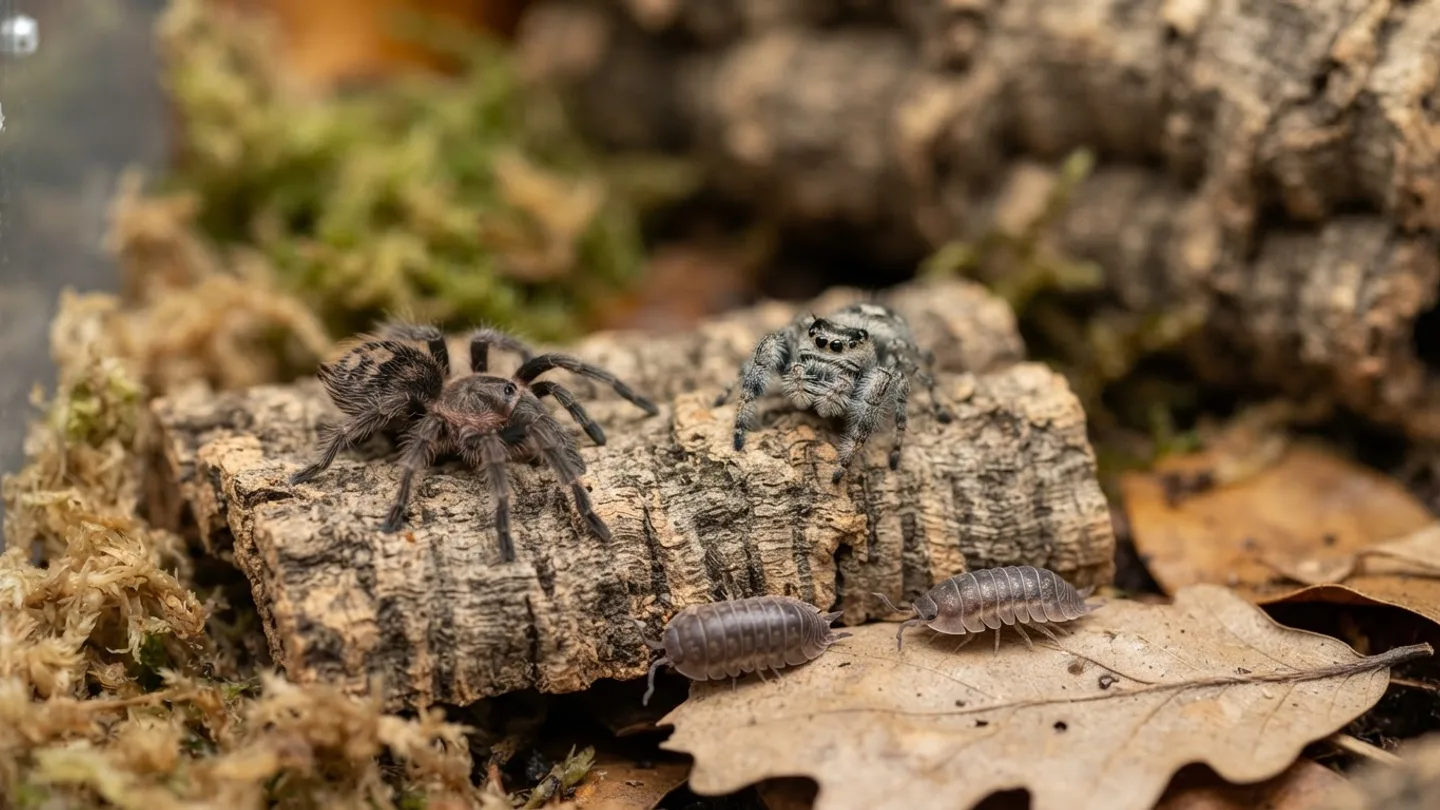
Pet Invertebrates for Beginners: Tarantulas, Jumping Spiders and Isopods
A first pet invertebrate does not need to be the most dramatic spider at the expo. It needs to fit your space, your schedule and your willingness to buy small live prey.
Tarantulas, jumping spiders and isopod cultures are the three common beginner paths in the US hobby. A tarantula gives a slow, stable display animal. A jumping spider gives an active, curious hunter that is small enough to keep on a shelf. An isopod culture gives a busy, low-handling colony that can be useful in a bioactive setup.
This overview compares cost, lifespan, space, handling and weekly care. Use the care guides to find species-specific pages before you buy a named morph or a named spider.
The short version
- A New World terrestrial tarantula is the lowest-effort beginner pet here: room temperature, a water dish and one feeding a week covers most of it.
- A jumping spider (Phidippus regius or P. audax) is the most interactive option, but it lives roughly 1 to 2 years and eats small live prey several times a week.
- An isopod culture is the most forgiving start and doubles as a clean-up crew in a bioactive terrarium. Start with a hardy Porcellio, not a Cubaris species.
- None of these animals should be handled daily, and none of them want a heat mat under the enclosure in a normally heated US home.
- Buy captive-bred animals from a breeder or expo vendor rather than wild-caught imports, and buy a spider for the species, not for a morph name.
| Factor | Tarantula (New World terrestrial) | Jumping spider (Phidippus spp.) | Isopod culture |
|---|---|---|---|
| Lifespan | Females of beginner New World species: often 15 to 25 years. Males: roughly 3 to 7 years total | About 1 to 2 years | About 2 to 4 years per individual, the colony continues |
| Enclosure size | Terrestrial adult: floor space about 2.5 to 3 times the leg span, roughly 8 to 12 inches per side for a 5-inch spider | 4 x 4 x 8 inches (L x W x H) for one adult, taller than wide | A 6-quart shoebox-sized bin (about 15 x 10 inches) holds a starter culture |
| Temperature | 70 to 78 degrees F, normal room temperature | 72 to 82 degrees F, they do best toward the warmer end | 68 to 80 degrees F for hardy starter species |
| Feeding | Sling: 2 times a week. Adult: 1 to 2 prey items a week, prey no larger than the abdomen | Spiderling: daily fruit flies. Adult: a fly or small cricket every 2 to 3 days | Leaf litter always available, plus a small protein or vegetable offering 1 to 2 times a week |
| Handling | Not recommended; observe only | Brief, voluntary hand-walking is possible | Fine to handle briefly; the culture is better left undisturbed |
| Weekly time | About 10 minutes | About 20 to 30 minutes, plus prey upkeep | About 10 minutes once established |
Option one
Tarantulas: the slow, steady choice
For a first tarantula, look at slow-growing New World terrestrial species, meaning ground-dwelling species from the Americas. Reliable starter species include the curly hair tarantula (Tliltocatl albopilosus, formerly Brachypelma albopilosum), the Mexican red knee (Brachypelma hamorii) and the Chilean rose hair (Grammostola rosea). These tolerate a keeper's mistakes, accept prey readily and rarely flick urticating hairs, the barbed defensive hairs New World species kick from the abdomen.
Housing is simple. A terrestrial adult with a 4 to 5 inch leg span needs floor space about 2.5 to 3 times that leg span, so a tank or acrylic enclosure around 10 to 12 inches long and 8 to 10 inches wide. Height matters less; too much height above the substrate is a fall risk, and a fall can rupture a tarantula's abdomen. Fill the enclosure with 3 to 4 inches of slightly dry to barely moist substrate, such as coco fiber or topsoil without fertilizer, add a hide, a cork bark piece and a full water dish, and you are done.
Temperature: 70 to 78 degrees F is fine for these species, which is ordinary US room temperature. Do not put a heat mat under the enclosure. It dries the substrate unevenly and can cook an animal that cannot move away from it. If your home drops below about 65 degrees F in winter, warm the room, not the tank.
Feeding is the part new keepers overdo. A sling, the hobby term for a baby spider, eats 2 small prey items twice a week. A juvenile eats once or twice a week. A healthy adult eats 1 to 2 crickets or roaches a week, each no larger than the spider's abdomen. A fat adult that refuses food for weeks is usually in premolt, the quiet fasting period before shedding its exoskeleton, and that is normal. Remove uneaten prey within 24 hours.
Honest warnings: Grammostola rosea has a reputation for random fasting that can last months, which alarms beginners even though the spider is fine. And avoid Old World species such as the orange baboon tarantula (Pterinochilus murinus) as a first spider. They are fast, defensive and medically significant compared to New World species. They are poor first tarantulas, full stop.
Option two
Jumping spiders: small, curious and short-lived
The two common beginner species in the US are the regal jumping spider (Phidippus regius) and the bold jumping spider (Phidippus audax). Both are active during the day, track movement with their big forward eyes and will often turn to watch you. If you want an invertebrate that feels interactive, this is it.
Housing is vertical. One adult does well in an enclosure about 4 x 4 inches of floor space and 8 inches tall, with cross ventilation, meaning vents on two opposite sides so air actually moves. Stagnant, humid air is a bigger killer of jumping spiders than a dry week. Add a small anchor point near the top, a twig or a piece of cork bark, because the spider builds its retreat near the highest point.
Temperature: 72 to 82 degrees F, with the mid-to-upper 70s as the sweet spot for P. regius. They bask under a lamp if you offer one, but an ambient warm room is enough. Humidity is managed with a light mist on one side every day or two, not with wet substrate.
Feeding is more frequent than with a tarantula. Spiderlings eat flightless fruit flies, ideally every day. Adults eat a house fly, blue bottle fly or small cricket every 2 to 3 days, prey roughly the size of the spider's abdomen or smaller. Many keepers order fly spikes, the pupae that hatch into feeder flies, every couple of weeks. If buying live prey several times a month sounds tedious, a tarantula or isopods fit you better.
The trade-off is lifespan. From spiderling to old age you get roughly 1 to 2 years, and a mature male often fades within months of his final molt. Females live longer and can lay infertile egg sacs even without a male, which is normal and not a problem. Know this going in so the short run does not feel like a failure of care.
One more thing, and it is good news: a jumping spider you found in your house is almost certainly a Phidippus species, usually P. audax in much of the US, and it can be kept with exactly this setup. Captive-bred spiderlings from a breeder are hardier and used to people, but a healthy wild adult is a legitimate free starter.
Option three
Isopods: a culture, not a pet you hold
Isopods are the most forgiving entry point in the hobby and the most useful one. A starter culture of a hardy species like the dairy cow isopod (Porcellio laevis) or the common roly-poly (Armadillidium vulgare) will tolerate a wide range of keeper mistakes while it builds numbers.
Setup is a ventilated plastic bin of about 6 quarts, roughly 15 x 10 inches, with 2 to 3 inches of substrate: topsoil without fertilizer mixed with leaf litter and a little decaying wood. The key instruction is a moisture gradient. Keep one corner consistently moist, sphagnum moss works well, and let the opposite side stay dry. The isopods regulate themselves by moving along the gradient. A bin that is wet wall to wall crashes cultures.
Temperature: 68 to 80 degrees F covers the hardy starter species, so room temperature again. They eat their leaf litter and decaying wood around the clock; you add a thumbnail-sized piece of vegetable or a pinch of fish flakes or dried shrimp for protein 1 to 2 times a week, and remove leftovers before they mold.
Where beginners go wrong is buying by morph name instead of species. The rubber ducky isopod, for example, is a Cubaris species from Thailand: it needs high, stable humidity, breeds slowly and costs far more than a Porcellio. It is a poor first culture. Start with P. laevis or A. vulgare, learn what a thriving bin looks like, and move to Cubaris later if you still want to.
A note on buying legally and sensibly: buy captive-bred cultures from US breeders. Some exotic isopods in the trade fall under USDA plant-pest rules and should only change hands with the right permits, and reputable sellers will say so. When in doubt, stick to the common captive-bred species above.
If you keep reptiles or amphibians, isopods plus springtails become your clean-up crew, the small invertebrates in a bioactive setup that eat waste, mold and shed skin so you deep-clean less often. For that job, P. laevis and dwarf white isopods (Trichorhina tomentosa) are the workhorses. Springtails need the moist corner; isopods use the gradient. The two together cover the whole bin.
Handling and safety, said plainly
Tarantulas do not benefit from handling, and every fall from hand height is a genuine injury risk. If you want to move one, coax it into a catch cup. Beginner New World species have mild venom and their bite is comparable to a bee sting for most people, but the realistic risk is not the bite, it is the urticating hairs. Those hairs itch and can embed in skin, and they are dangerous if they reach your eyes. Wash your hands after any contact and keep your face away from a flicking spider.
Jumping spiders are the one group here where light handling is reasonable, on the spider's terms. Let it walk onto your hand in front of its enclosure rather than grabbing it. Their bite is rare, usually defensive from a pinched spider, and is generally no worse than a mosquito bite. Never squeeze or trap one; a startled jumper can also fall, and their small size does not make falls safe.
Isopods can be handled briefly and are safe for supervised kids. They do not bite. The real rule with isopods is that the culture does better when you mostly leave it alone.
If you are a parent reading this for a teen's first spider: the species listed above are the safe end of the hobby. Supervise the first weeks, agree on a no-handling rule for the tarantula, and keep feeder insects contained. That covers the realistic risks.
How to choose tonight
Decide what you want to watch
Slow and statuesque: tarantula. Active hunter that notices you: jumping spider. Busy little ecosystem: isopod culture.
Check your timeline honestly
A female tarantula is a 15 to 25 year commitment. A jumping spider is 1 to 2 years. Isopods are ongoing but individual animals are short-lived and replaceable by the colony itself.
Check your prey tolerance
Tarantulas and jumping spiders need live prey. If crickets and fly cultures in the kitchen are a hard no, isopods are your answer.
Set up the enclosure before the animal
Buy or build the enclosure first, add substrate and water, and let it sit a day. An animal that arrives to a ready home skips the most stressful night in the hobby.
Buy captive-bred, buy the species not the morph
Captive-bred animals from breeders and expo vendors are hardier and ethically cleaner. A fancy morph name on the same species adds cost, not care requirements.
Beginner questions
Which of these is best for a total beginner?
For the least that can go wrong, an isopod culture of Porcellio laevis. For a pet you will actually watch, a juvenile curly hair tarantula (Tliltocatl albopilosus) at room temperature, 70 to 78 degrees F, with a full water dish and one or two feedings a week.
Do any of these need a heat mat or special lamp?
No heat mat for tarantulas or isopods in a normally heated home. Jumping spiders like it warmer, 72 to 82 degrees F, and will use a small basking lamp if offered, but a warm room is enough. Heat mats under enclosures cause more problems than they solve.
Can I keep a jumping spider I found in my house?
Yes, and it is almost certainly a Phidippus species. Give it a tall, ventilated enclosure around 4 x 4 x 8 inches, a light mist on one side every day or two, and a small fly or cricket every 2 to 3 days.
Are tarantula bites dangerous?
Beginner New World species have mild venom; most bites compare to a bee sting unless you are allergic. Old World species are a different matter and are not beginner spiders. The everyday risk with New World species is urticating hairs, which itch and must be kept away from your eyes.
Can I put isopods straight into my reptile's bioactive tank?
Yes, but culture them separately first for a few weeks so you start with a booming population, and add springtails alongside them for the moist areas. A small culture dropped into an active terrarium gets eaten before it establishes.
My new tarantula has not eaten in three weeks. Is it sick?
Probably not. Fasting for weeks is normal, especially before a molt. Keep the water dish full, remove uneaten prey within 24 hours and wait. Worry when the abdomen shrivels or the spider curls its legs under its body.
Ready to pick your first one?
You have the overview. The next step is the species page for the animal you picked, with enclosure dimensions, substrate, feeding by life stage and molt signs in one place.